
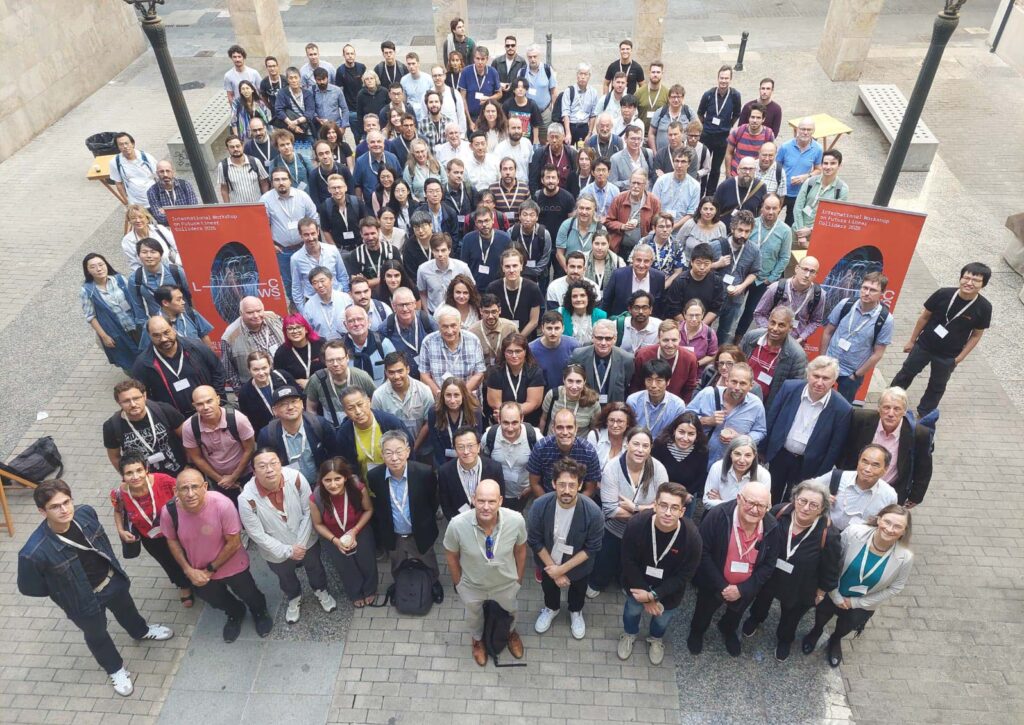
Under the Mediterranean sun, the old town of Valencia, Spain, became a hub of energy and ideas as more than 300 physicists, engineers, and students gathered for the 2025 International Workshop on Future Linear Colliders (LCWS 2025). Hosted by IFIC (CSIC/University of Valencia), the workshop brought together the global community working toward the realisation of a next-generation electron–positron linear collider — a precision instrument designed to explore the Higgs boson, the top quark, and physics beyond the Standard Model.
With the upcoming update of the European Strategy for Particle Physics, LCWS 2025 served not only as a technical review but also as a strategic forum for shaping the field’s future direction. Participants examined the latest developments from the three main linear collider concepts — the International Linear Collider (ILC), CLIC, and C³— as well as advances in novel acceleration schemes, discussing how each could serve as a “Higgs factory” and beyond.
“This year, the workshop beautifully reflected the collaboration and continuity within the linear collider community,” said Adrián Irles, Chair of the Local Organising Committee of LCWS 2025. “A highlight was the special poster session, which paid tribute both to the history of LCWS and to the creativity of early-career researchers. Inspired by Antonio Machado’s verses — ‘Caminante, no hay camino, se hace camino al andar’ — we celebrated the new paths being forged by young scientists, while ‘Caminante, no hay camino, sino estelas en la mar’ reminded us of the lasting marks left by those who came before,” added Daniel Esperante, another Chair of the Local Organising Committee for the workshop.
Throughout the week, plenary sessions provided updates on accelerator technology, detector development, and physics prospects. Researchers presented significant advances in high-gradient RF systems, beam delivery, and particle-flow detectors, while emphasizing realistic staging scenarios and the importance of international collaboration to bring a future collider from concept to construction.
Detector teams showcased progress on vertex and calorimeter prototypes, and software experts led tutorials on Key4hep, a unified framework for simulation and reconstruction. Early-career physicists played a prominent role throughout, underscoring the community’s commitment to training and open collaboration.
“The enthusiasm and exchange of ideas throughout the workshop truly embodied the spirit of our community,” the Local Committee Chairs added.
Beyond technical sessions, much of the discussion centred on the path forward — ensuring that the next update of the European Strategy and national science agencies receive coordinated, coherent input from the linear collider community. Participants highlighted the need for comparative studies of physics reach, cost, and technological readiness across collider options, as well as continued R&D on high-gradient structures, beam-delivery stabilisation, and detector prototype validation.
As LCWS 2025 came to a close, participants left Valencia with renewed energy and a shared sense of purpose. Whether the next major collider takes shape as the ILC in Japan, the LCF at CERN, or another emerging concept, the community remains united by a single goal: to build the precision tool that will define the next era of particle physics.
Recent Comments